



Brazilian Youth Awarded for Creative Digital Mental Health Interventions
São Paulo — Juntô, the Brazil initiative of the Stavros Niarchos Foundation (SNF) Global Center for Child and Adolescent Mental Health at the Child Mind Institute (CMI), and the Instituto Felipe Neto announce today on World Youth Day the winners of the “Bem na Rede: Competition for Healthy Technology Use!”. The competition invited Brazilian youth aged 16 to 20 to create scalable digital interventions aimed at promoting a healthier and more intentional use of technology.
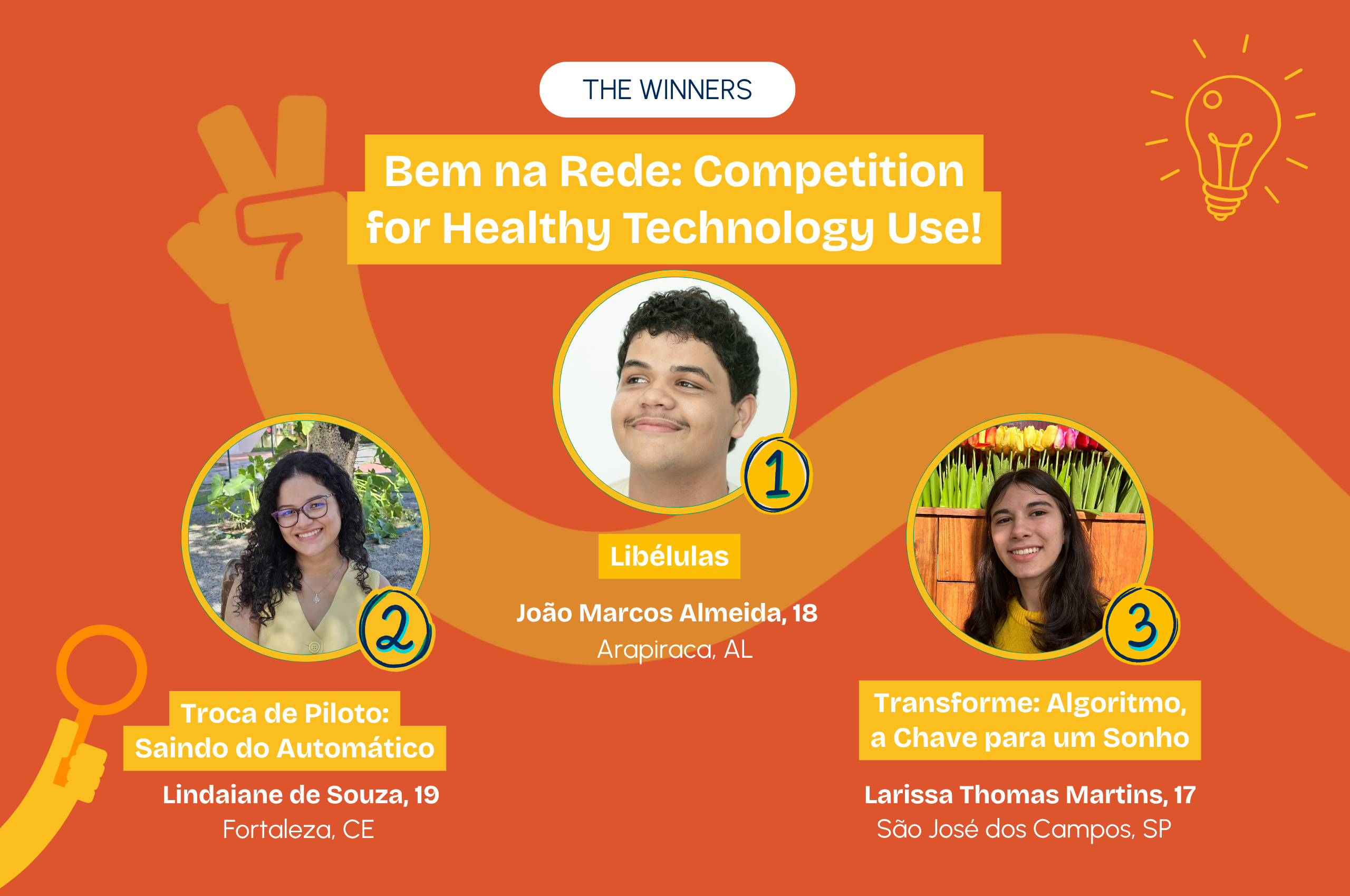
The winning youth who will see their creations help youth across the country are João Marcos Almeida dos Santos from Arapiraca (AL), Lindaiane de Souza Santos from Fortaleza (CE), and Larissa Thomas Martins de Siqueira from São José dos Campos (SP). They will receive prizes of R$5,000, R$4,000, and R$3,000, respectively — from USD 950 to USD 550 approximately.
From emotional regulation and self-esteem to navigating digital spaces with healthy boundaries, the submitted projects—including theirs—covered a vital spectrum of youth mental health topics. All of this work was made possible by being developed on the Child Mind Institute’s Curious digital platform.
Technology as a Good Place
“As a child, I was passionate about digital games, trends, and everything the algorithm sent my way. During the pandemic, I became even more isolated. I was on my phone all day, sleepless nights, feeling unwell, not really talking to anyone. When school resumed, it was a shock, I was no longer the same person,” says João Santos. “My project addresses the main challenges of excessive social media use and the algorithms that trap us for hours without us even noticing. I hope my project helps other young people gain the same self-awareness I did, change their online habits, know how to ask for help when needed, and understand that it’s possible to turn technology into a good place.”
Carolina Costa, the SNF Global Center’s country manager in Brazil, highlights the quality of the submitted interventions. “We received excellent projects, demonstrating the immense potential of young people to create real solutions for their own generation. The proposals were technically evaluated by experts in Single Session Interventions and user experience and also reviewed by other young people who assessed the likelihood of youth adoption. The demand for scientific evidence was a distinguishing factor, ensuring that finalists presented solid, validated strategies,” says Costa. “Young people’s capacity for achievement is often underestimated, but this selection process proved the contrary, when given the opportunity to create, they deliver excellence. Choosing the best was a difficult task for our panel.”

"I hope helping other young people gain the same self-awareness I did, change their online habits, know how to ask for help"
- João Santos, winner of the competition
Encouraging Positive Reflection
The competition follows the Single Session Intervention (SSI) model. SSIs are structured, one-time encounters designed to provide meaningful support or treatment in a single session. They are evidence-based, flexible, accessible interventions capable of significantly reducing distress or improving mental health by encouraging the person to take a concrete next step.
The challenge is simple and the final product is a guided experience in which users answer questions and watch videos and images that stimulate positive reflection or concrete actions to improve their mental health.
“Our goal is to encourage the creativity and transformative power of new generations in building a healthier and more humane digital future,” says Camilo Coelho, communications director of the Instituto Felipe Neto. “This competition is part of an effort to engage young people in mental health initiatives that reflect their experiences and meet the constantly evolving needs of their peers.”
About the Interventions (click on the names to access them)
Libélulas (Dragonflies): This project created by João Marcos Almeida dos Santos from Arapiraca (AL) works as an interactive form with deep questions designed to make people think, self-analyze, and gently self-reflect without judgment, in a way that is welcoming and invites honest reflection, touching on real fears such as comparison, anxiety and also on hope. At the end, the system generates a personalized report that analyzes the responses, identifies patterns and vulnerabilities, but above all strengths and possibilities for change, with a simple, concrete plan adapted to the person’s reality. It is education through example, empathy, and the living metaphor of the dragonfly that, even when threatened, flies free and shines. It is an invitation to stop merely being used by the internet and begin using it consciously, positively, and creatively.
Troca de Piloto (Pilot Switch): This project addresses how social media can feel kind of exhausting—and many think that it’s by design as social media addiction has been compared to dopamine-driven rewards systems. This project created by Lindaiane de Souza Santos from Fortaleza (CE), is a user’s guide to get out of that loop. For teens, de Souza Santos thinks that social media believes apps trigger two buttons in their brains: the panic button (the fear of missing out or not measuring up) and the treat seeker (always chasing the next like, notification or scroll). Instead of getting stuck in endless loop her app teaches her users how to flip the switch to calm-down mode. The central goal is to teach users to deliberately access the self-soothing system responsible for the feeling of security. The project aims to foster self-compassion: by being asked to advise a friend in a situation similar to their own, participants practice the transition from inner critic to inner ally.
TRANSFORME (TRANSFORM): This project designed by Larissa Thomas Martins de Siqueira from São José dos Campos (SP) centers on the idea of encouraging young people to reflect on who they are, what their emotions and interests are, and how social media can be used in this pursuit of self-knowledge. As the user navigates through the intervention she created they encounter data on Brazil’s alarming mental health statistics, questions about time spent on social media and information on how algorithms work to make users addicted. Her project is designed to spark reflection and raise questions on how social media use affects young people and in turn develop healthier online habits.
About the SNF Global Center
The SNF Global Center is dedicated to strengthening mental health systems and improving outcomes through training, expanding access to care, and evidence-based solutions. The initiative leads and supports cross-cultural partnerships, promotes youth-developed solutions, and is supported by the Stavros Niarchos Foundation (SNF) as part of its Global Health Initiative (GHI), in collaboration with the Child Mind Institute (CMI).
About the Instituto Felipe Neto (IFN)
The Instituto Felipe Neto is a non-profit civil society organization created to positively impact the lives of children, adolescents, and young people. It operates in three main areas (mental health, media literacy, and philanthropy) and is committed to promoting well-being, critical thinking, and social responsibility in new generations, preparing them to navigate safely through the challenges of the contemporary world.
Press Releases
March 30, 2026Give us your
feedback
Let us know what topics you would like to see on our website