




Mental health challenges in children and adolescents are huge, but can be overcome
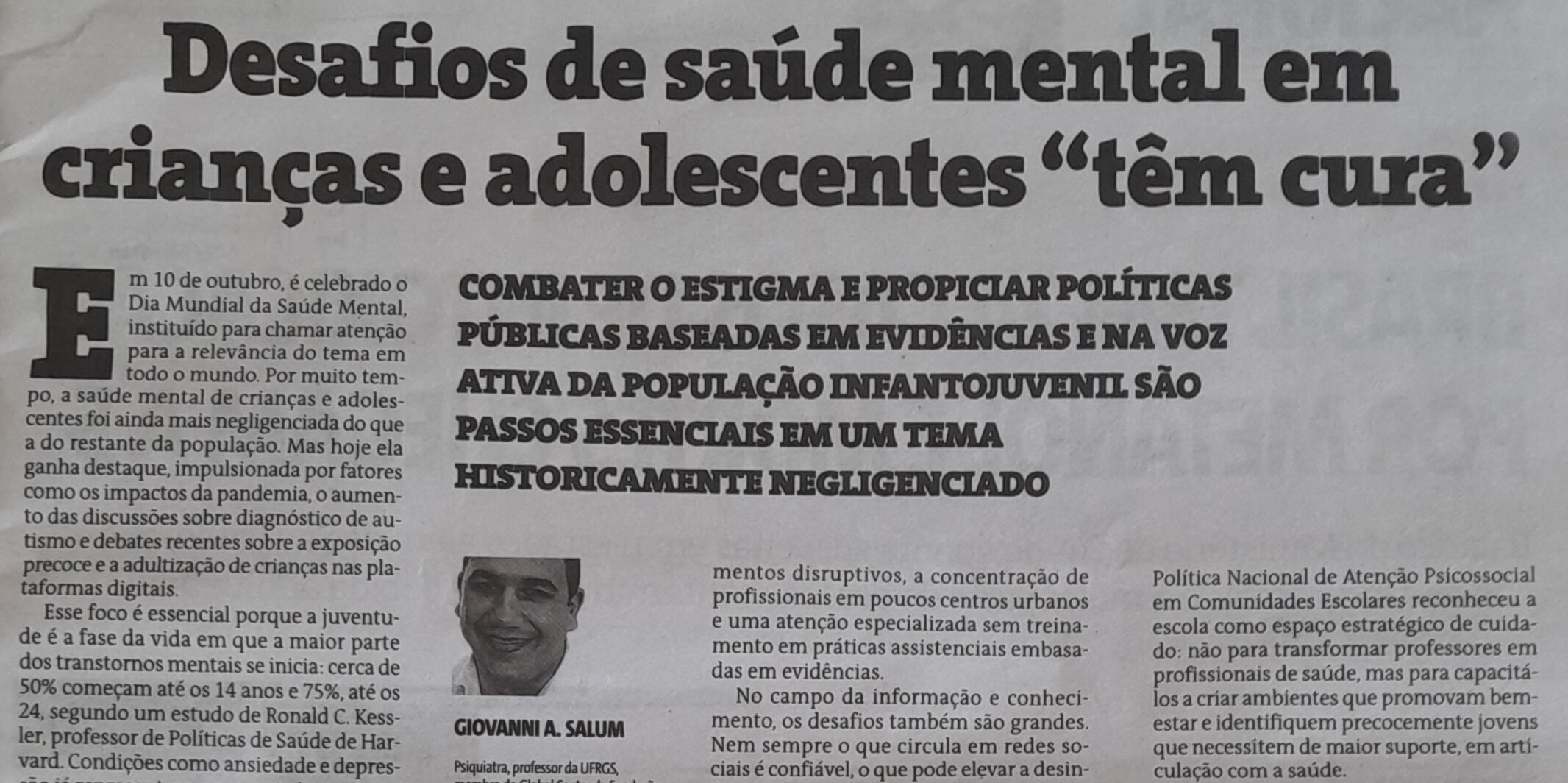
(Originally published in the Estado de Minas newspaper, October 9 edition (photo above), and on the Sul 21 portal on October 10, 2025)
This October 10, we observe World Mental Health Day, established to draw global attention to the relevance of this issue. For a long time, the mental health of children and adolescents was even more neglected than that of the rest of the population. Today, however, it has become more prominent, driven by factors such as the impacts of the pandemic, the growth of discussions surrounding autism diagnosis, and recent debates about early exposure and the “adultification” of children on digital platforms.
This focus is essential because youth is the stage of life in which most mental disorders begin: about 50% start by age 14 and 75% by age 24, according to a study¹ by Ronald C. Kessler, professor of Health Policy at Harvard. Conditions such as anxiety and depression already represent a significant share of the disease burden in this age group, and studies indicate that their prevalence has increased in recent years. Suicide ranks among the leading causes of death among young people, including in Brazil, which has more than 50 million children and adolescents, according to the IBGE.
Despite growing attention to the issue and major advances—such as the expansion of the Psychosocial Care Network (RAPS), including child and adolescent Psychosocial Care Centers (CAPSi), of which there are now 324 in the country—we are still far from meeting the existing needs. Researchers from USP, Unifesp, and UFRGS² estimate that 80% of young people experiencing psychological distress do not receive specialized care, even in major capitals. Key obstacles include stigma; a primary care network lacking effective therapeutic alternatives—particularly psychosocial interventions—for common mental health conditions such as anxiety, depression, and disruptive behaviors; the concentration of professionals in a few urban centers; and specialized services that lack training in evidence-based clinical practices.
In the field of information and knowledge, the challenges are significant as well. Content circulating on social media is not always reliable, which can heighten misinformation and lead to incorrect self-diagnoses, labeling common experiences as disorders. Despite the growth of Brazilian scientific output since the 2000s, there is still a shortage of representative data on the prevalence of mental disorders among children and adolescents. A review³ conducted by our group of studies carried out in Brazil identified rates around 13%, similar to global estimates, but these data mostly come from samples in the South and Southeast regions, lacking national representativeness. This gap undermines the planning of public policies and the strengthening of advocacy efforts to establish this issue as a national priority.
Active participation of young people
In light of this scenario, recent initiatives point to important paths forward. In 2024, the creation of the Working Group on the Mental Health of Children, Adolescents, and Youth at the Ministry of Health represented a step toward updating guidelines and consolidating specific regulations for this population. Also in 2024, the approval of the National Policy for Psychosocial Care in School Communities recognized schools as strategic spaces of care—not to turn teachers into health professionals, but to equip them to foster environments that promote well-being and identify early on those young people who may need additional support, in coordination with the health sector.
In line with this agenda, what organizations and other actors engaged in this cause must do is participate in transformative projects grounded in the active involvement of young people—integrating new generations into the search for solutions—and enabled by the combined efforts of partner institutions, which help build collaborative pathways for implementing new legal frameworks, and, at the other end, encourage their formulation.
Although the challenges are considerable, speaking openly about mental health, combating stigma, engaging in genuinely committed partnerships, and providing the population with public policies grounded in evidence and the active voices of children and adolescents are essential steps to ensure that young people grow up with more health, dignity, and hope, and are able to fully realize their aspirations and potential in life.
Giovanni A. Salum, psychiatrist, is Senior Vice President of the Global Center of the Stavros Niarchos Foundation (SNF) for child and adolescent mental health at the Child Mind Institute (CMI) and professor at the Federal University of Rio Grande do Sul (UFRGS); Julio Cruz Neto, journalist, is Communications Consultant at Juntô – Brazilian Initiative for Child and Adolescent Mental Health; Caio B. Casella, child and adolescent psychiatrist, is Clinical Data Analyst at the Global Center of the Stavros Niarchos Foundation (SNF) for child and adolescent mental health at the Child Mind Institute (CMI).
- Kessler RC, Berglund P, Demler O, Jin R, Merikangas KR, Walters EE. Lifetime prevalence and age-of-onset distributions of DSM-IV disorders in the National Comorbidity Survey Replication. Arch Gen Psychiatry. 2005 Jun;62(6):593-602. doi: 10.1001/archpsyc.62.6.593. Erratum in: Arch Gen Psychiatry. 2005 Jul;62(7):768. Merikangas, Kathleen R [added]. PMID: 15939837.
- Fatori D, Salum GA, Rohde LA, Pan PM, Bressan R, Evans-Lacko S, Polanczyk G, Miguel EC, Graeff-Martins AS. Use of Mental Health Services by Children With Mental Disorders in Two Major Cities in Brazil. Psychiatr Serv. 2019 Apr 1;70(4):337-341. doi: 10.1176/appi.ps.201800389. Epub 2019 Jan 17. PMID: 30651056.
- ref: https://www.medrxiv.org/content/10.1101/2024.11.10.24317061v2
CAMHI BR in the Media
November 28, 2025Give us your
feedback
Let us know what topics you would like to see on our website