




“Nothing about us without us”: youth build the future of mental health in Brazil
(originally published by Nexo Políticas Públicas, in November 25th, 2025)
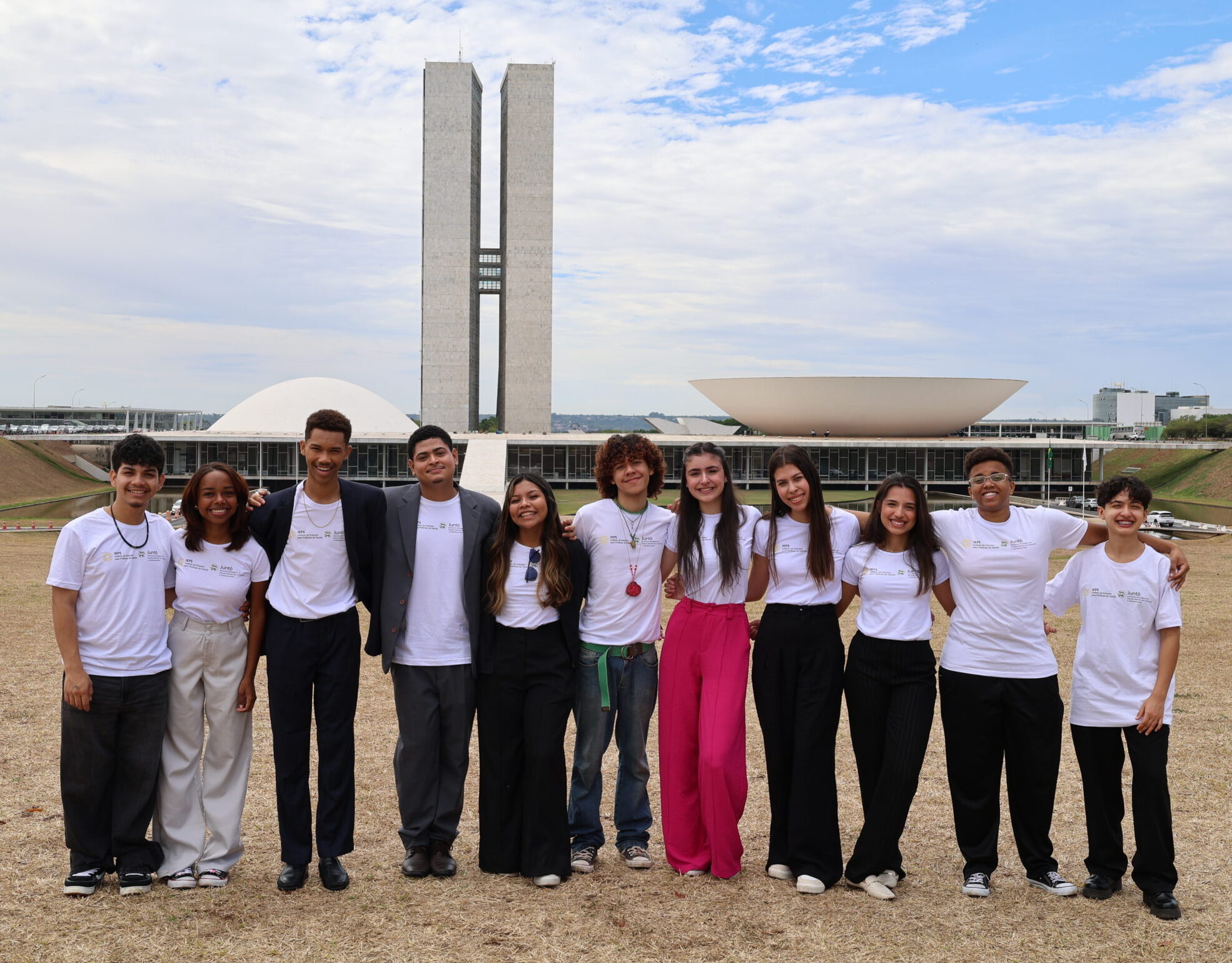
From October 13 to 15, young people from various parts of Brazil gathered in Brasilia for a different kind of meeting. The goal was to make the most of being together in person to exchange ideas and propose collective actions on mental health, as a continuation of the learning track that has been taking place through biweekly virtual meetings since April of this year. These were days of listening, connection, and reflection on how what each person experiences is not only individual, but also collective and shaped by the country’s social and political realities.
The development of mental health policies for children and adolescents in Brazil is relatively recent: it began to be placed on the public-health agenda just over two decades ago. In this sense, opening paths for young people to take the lead—not only as a target audience, but as protagonists of the changes they want to see—is a first step toward a more participatory practice that is conscious of rights.
Between one conversation and another, the group discussed how mental health is not an isolated topic, but the thread that stitches together the possibilities of living with dignity. In that regard, if there was a shared perspective among all the young participants, it was that you cannot talk about mental health without talking about inequality, race, gender, access, and care—issues that are part of the real needs of young people. They carry the awareness of those who understand that mental health is not just the absence of suffering, but also the presence of dignified conditions for existence.
For Daniel Nascimento, from the Youth Council of the Child and Adolescent Mental Health Initiative (CAMHI) Brazil, in partnership with IEPS (Institute for Health Policy Studies), these needs involve more than psychosocial support and attention—they also include access to basic policies of dignity.
“When it comes to mental health, what we’re demanding is foundational; it involves more mental-health services in primary care, more psychologists, more multidisciplinary teams, and better-structured facilities. But beyond that, it involves having a city built for everyone—one that considers safety, health, leisure, culture, and access to resources that go beyond leaving home, going to work, and using public transport. Mental health involves all of that; it involves well-being and dignity,” Daniel says.
National laws and policies mean nothing if, on the ground, there are no sensitive and engaged people, with real force to make things happen Marina da Silva, Youth Council
Marina da Silva, also part of the youth committee of Juntô, adds: “We, as young people, are also calling for greater understanding of mental health, for people to treat the topic with more seriousness. Sometimes even schools can reproduce these forms of violence; that’s why our demands involve valuing the issue, with multidisciplinary support that welcomes differences and knows how to act within the diverse realities.”
Daniel continues: “Before thinking about budget transfers and the underfunding of the Unified Health System, we need to talk about the importance of seeing mental health as something basic. It’s not whining, it’s not nonsense—it’s urgent. People need to understand that mental health involves multiple dimensions, and combating stigma is the first step.”
This shows the power of bringing together young people from so many different places: realizing that pains and dreams take on new dimensions when they become collective. It becomes clear that young people do not want to be called only when decisions have already been made. On the contrary, they want to participate from the beginning, to design together, to propose solutions that make sense for their realities, and to have the autonomy to try what does not yet exist.
As committee member Júlio Ruan Ferreira points out: “We young people are being heard, but we need to be heard more genuinely and effectively, with mechanisms for real participation, authentic representation, and civic education so that our voices are considered and respected.”
At the meeting, it became clear that the future of mental health must move beyond closed-off approaches or programs that do not listen to those on the ground, because progress depends on the courage to recognize that young people know precisely what affects them in their daily lives and that they are central agents in these discussions. They know the impact of violence on territories and bodies, of inequalities that limit dreams, of schools that fail to embrace differences, and of cities that do not protect.
This is why spaces like Juntô Jovem are urgent; it is not enough to talk about youth—you must talk with them, and more than that, allow them to speak for themselves. When young people are at the decision-making table, care stops being a distant idea and becomes part of everyday life. Public policies developed with direct youth participation are more aligned with reality, more effective, and avoid solutions disconnected from the people who will actually live them. It is there—where public policy meets lived experience—that more honest, humane, and above all, more collective and effective paths emerge.
Remarkable moments
In Brasilia, these listening spaces were constant, but a few stood out: one was the visit to the country’s first Child Psychosocial Care Center (CAPSi), a symbol of the anti-asylum movement and of community-based care.
Next, the young participants delivered to the Minister of Education, Camilo Santana, and to members of the Joint Parliamentary Front for the Promotion of Mental Health a monitoring report with proposals on implementing the Mental Health Policy in Schools— a document produced through the oversight work of the Parliamentary Front. The report was analyzed and revised by committee members based on their experiences in different regions. Finally, they took part in a meeting with the national coordinator of Mental Health at the Ministry of Health, Marcelo Kimati, to discuss ways to ensure effective youth participation in public policies.
Ruan adds: “These spaces strengthen the voice of youth, influence public policies, and promote civic participation, representing an opportunity for expression, empowerment, and skill development for young people.”
Marina adds: “The meeting changed how I see mental health in my region. Living in a small city, I realized that access to care isn’t simple; it’s complex work that only happens because there are committed professionals collaborating and caring for people. National laws and policies mean nothing if, on the ground, there are no sensitive and engaged people—because it is from them that the real force to make things happen comes.”
About the authors
Daniel Nascimento is a council member of the State Council for the Defense of Children and Adolescents and a social communicator at Rede Não Bata, Eduque. He began his activism at the Child and Youth Psychosocial Care Center (CAPSi) Pequeno Hans, advocating for the rights of children and adolescents. Daniel is a member of Juntô Jovem.
Júlio Ruan Ferreira is a student at IFB (Federal Institute of Brasília). Passionate about music, films, and art, he dedicates himself to helping others navigate mental-health challenges. Júlio is a member of Juntô Jovem.
Marina da Silva is passionate about education, social projects, and photography. She participates in initiatives dedicated to the common good and reducing social inequalities. Marina is a member of Juntô Jovem.
Camila Fortes Franklin is a journalist, holds a PhD in Health Information and Communication (Fiocruz), with a sandwich doctorate at the Center for Social Studies at the University of Coimbra in Portugal, and a Master’s degree in Communication (UFPI). She is a communication and mental-health consultant at Juntô—the Brazilian Initiative of the Stavros Niarchos Foundation (SNF) Global Center for Child and Adolescent Mental Health at the Child Mind Institute (CMI).
Filipe Asth is an institutional relations specialist at the Institute for Health Policy Studies and executive secretary of the Joint Parliamentary Front for the Promotion of Mental Health. He is a psychologist, holds a Master’s degree in Psychology from UFF, and a PhD in Public Policy from UERJ.
CAMHI BR in the Media, Our Voices
November 28, 2025Give us your
feedback
Let us know what topics you would like to see on our website