




Innovative Training Seeks to Help Teachers Support Student Mental Health in Southern Brazilian State

Porto Alegre (Brazil) – Many mental health issues begin in childhood and adolescence, and teachers are in a strategic position to notice when something is wrong. However, they often face this responsibility without adequate support, as most do not receive training on how to recognize or handle such situations. Filling this gap is the objective of the Psychosocial Support Program in Schools (PSP), developed by the Stavros Niarchos Foundation (SNF) Global Center for Child and Adolescent Mental Health at the Child Mind Institute—and implemented in Rio Grande do Sul, Southern Brazil, through a partnership with the State Department of Education (SEDUC-RS), based on a Memorandum of Understanding signed in March 2026.
The program, aimed at school teams in elementary, middle, and high schools within the state public network, includes a pilot in 300 schools, which will be randomly selected to receive training in different formats—virtual, in-person, and asynchronous, both with and without supervision.
Approximately 90 managers from the Regional Education Coordinaries participated in a meeting in Porto Alegre on April 28 and 29 for the program presentation, as well as other aspects related to this matter, such as a mapping of mental health initiatives in schools across the country. The pilot is scheduled to begin in June, in Porto Alegre.
In addition to offering relevant content to the school context, the implementation of the PSP in Rio Grande do Sul aims to identify which types of training and approaches are most effective and how the program can be expanded to other schools in the state and other regions of Brazil. This will directly inform public policies and large-scale initiatives—always with care and sensitivity to local realities to respect the workload and demands of schools and their staff.
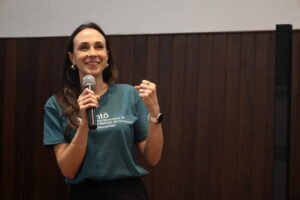
Julia Schafer, Program Manager at the SNF Global Center, presented PAPE to managers of the Regional Education Coordinating managers
Tools for Everyday Practice
“PSP will evaluate different ways of offering the training program to discover what works best in the real school environment, respecting the time and expertise of teachers,” says Luis Augusto Rohde, scientific lead of the SNF Global Center in Brazil. “The program was designed to offer practical tools to teachers, with special attention to not transferring diagnostic responsibility to them, and recognizing the importance of coordination with public health, social assistance, and justice services when necessary. The mental health of children and adolescents is everyone’s responsibility.”

Carlos Ramos de Lima (on the side) and Mariana Chaves, members of the SNF Global Center Youth Council in Brazil, presented a mapping of mental health initiatives in schools
Benefits of Participation
For teachers, the program offers the development of practical skills to recognize signs of mental health difficulties in students, provide appropriate classroom support and accommodations, and understand when and how to refer students to specialized care networks (health, social assistance, etc.). It also helps increase confidence in managing challenging situations and encourages reflection on the well-being of the school staff themselves.
For students, the benefits can be significant, greater support within the classroom, early identification of mental health needs, and, consequently, a more welcoming school environment.
For schools and society, the program aims to contribute to building safer school environments, reducing the stigma surrounding mental health, and supporting the implementation of national mental health policies.
In Rio Grande do Sul, mental health challenges among adolescents follow a significant national trend. Recent data from the National Survey of School Health (PeNSE) indicate an increase in symptoms such as anxiety, persistent sadness, and feelings of loneliness among students—an impact that is more pronounced among girls but growing across all groups. Adding to this scenario is the impact of recent natural floods that affected the emotional well-being of children, adolescents, and their communities. In this context, structured, evidence-based initiatives like PSP become even more vital.
About the SNF Global Center
The Stavros Niarchos Foundation (SNF) Global Center for Child and Adolescent Mental Health at the Child Mind Institute (CMI) brings together CMI’s expertise and SNF’s strong commitment to supporting collaborative projects aimed at expanding access to quality healthcare worldwide. The Global Center establishes partnerships to drive progress in under-researched areas of child and adolescent mental health and to expand access to culturally adapted training, resources, and treatments in low- and middle-income countries. This work is led by CMI with support from SNF through its Global Health Initiative (GHI).
About the Child Mind Institute
The Child Mind Institute is dedicated to transforming the lives of children and families struggling with mental health disorders and learning difficulties by giving them the support they need. The institution has become the leading independent nonprofit in children’s mental health by providing gold-standard evidence-based care, delivering educational resources to millions of families each year, training educators in underserved communities, and developing innovative treatments.
Give us your
feedback
Let us know what topics you would like to see on our website